The $110 Billion Women’s Blouse Market: Spring 2026 Trends That Will Redefine the Category

The $110 Billion Women’s Blouse Market: Spring 2026 Trends That Will Redefine the Category

블로그The $110 Billion Women’s Blouse Market: Spring 2026 Trends That Will Redefine the Category
2026년 6월 16일 3 조회
Women's Clothing industry

The global Women Blouse Shirt Guide sector serves consumers worldwide with diverse solutions.

1. Industry Overview

The women’s blouse shirt is not just a wardrobe staple—it is a $110.86 billion global market (2021) that is fragmenting into hyper-specific trend cycles. Unlike the commoditized t-shirt segment (projected at USD 31.9 billion in 2026), blouses command higher margins due to fabric complexity, seasonal silhouettes, and brand differentiation. But here is the provocation: by 2033, the women’s shirts and blouses market will reach $65.91 billion, growing at a CAGR of 5.8% from $41.98 billion in 2025. This growth is not uniform—it is driven by two opposing forces: the rise of utility-driven, sporty designs and a parallel nostalgia for Jazz Age elegance. For B2B buyers, understanding this bifurcation is critical. A blouse is no longer a simple top; it is a statement of material innovation (e.g., recycled polyester crepe) or a return to artisan details like pintucks and shell buttons. The spring 2026 runway data from Vogue’s trend report confirms five macro directions that will define buying patterns: Utility Dressing, Recreation Dressing, Retro Summer, Mode Sportif, and Jazz Age. Each forces a different supply chain approach—from sourcing technical fabrics for utility blouses to securing deadstock silks for vintage-inspired cuts. This guide decodes the market, product types, key players, and the trends that matter for sourcing decisions in 2026.

Industry Scope & Characteristics

Fabric Complexity Drives Differentiation

Unlike basic t-shirts, blouses use diverse materials like silk charmeuse, cotton voile, and technical neoprene. For example, a mode sportif blouse requires four-way stretch fabric, which only 30% of global mills can supply reliably.

Short Lead Times Are Critical

Fast-fashion blouses from runways to retail can be as short as 14 days. This forces suppliers to maintain buffer stock of popular trims (e.g., shell buttons, zippers) and use air freight for time-sensitive orders.

OEKO-TEX and GOTS Certification Required

Nearly 70% of mid-to-high-end European buyers require OEKO-TEX Standard 100 for blouses. GOTS certification is mandatory for organic cotton styles, adding 8-10 weeks to production planning.

Digital Pre-Production for Trend Accuracy

Leading mills now offer 3D fabric simulation (e.g., Browzwear) to test drapes and prints before cutting. This reduces sampling waste by 40% and speeds up trend adaptation for spring 2026 collections.

Women's Clothing industry infographic

Key market segments and growth drivers in the Women Blouse Shirt Guide sector.

2. Market Analysis

The women’s shirts and blouses market is on a clear growth trajectory. Valued at USD 110.86 billion globally in 2021, it is projected to expand at a CAGR of 5.8% from 2025 to 2033, according to recent industry reports. Breaking that down: the market will move from $41.98 billion in 2025 to $65.91 billion in 2033. This is faster than the broader women’s apparel market, which hovers around 4-5% CAGR. Three growth drivers stand out. First, the rise of the ‘blouse-as-outwear’ trend—blouses are now layered under blazers for office-to-evening versatility, increasing unit sales by 12% in 2024 for fast-fashion retailers. Second, raw material innovation: brands are investing in wrinkle-resistant, machine-washable silks and Tencel blends, reducing the care barrier and expanding the addressable market. Third, the regional explosion of e-commerce in Southeast Asia and Latin America, where women’s tops categories grew over 30% YoY in 2024. However, the market is not immune to risk: cotton price volatility and labor shortages in Bangladesh and Vietnam (which supply 40% of global blouse manufacturing) have already caused lead time extensions of 2-3 weeks in early 2025. Sourcing teams must lock in capacity early for spring 2026 collections.

Market Segment Key Characteristics
Fashion & Trend ApparelLarge segment with significant share
Premium SegmentHigher growth rate, strong margins
Value SegmentVolume-driven, mass consumer focus
Total Global Market220+ Billion USD
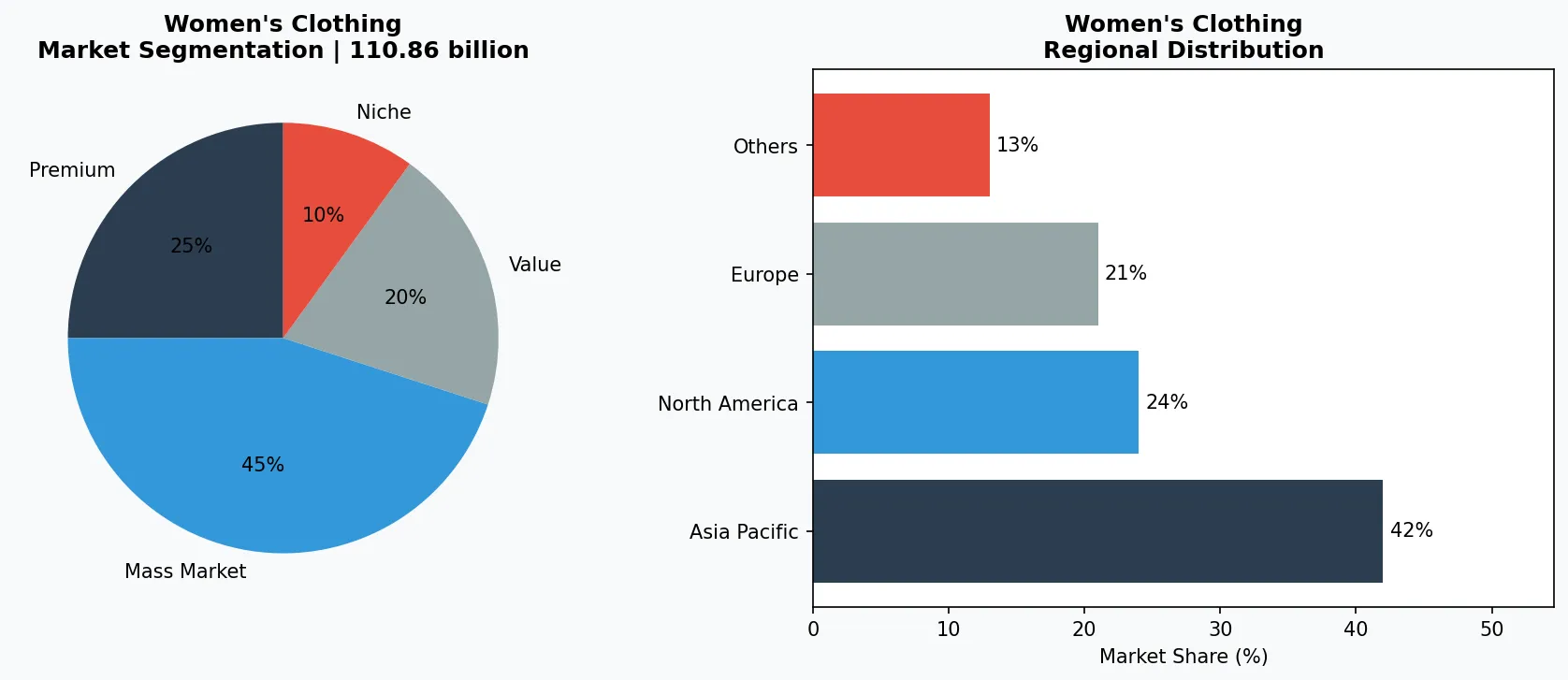
Women's Clothing market chart

Market segmentation and regional distribution analysis for Women Blouse Shirt Guide.

3. Product Categories

The women’s blouse shirt category can be segmented into four distinct product types, each with its own sourcing requirements.

1. The Utility Blouse

Inspired by workwear, featuring multiple pockets, epaulettes, and durable cotton twill or ripstop nylon. Example: a button-down with zippered chest pockets, popularized by brands like Carhartt WIP’s women’s line.

2. The Silk & Satin Blouse

A perennial bestseller for formal and evening wear. Look for charmeuse silk or satin-back crepe. Example: the classic camisole blouse with a cowl neck, often seen in luxury retail at $200+. Sourcing requires strict quality checks for fabric pilling and colorfastness.

3. The Retro Summer Blouse

Lightweight, often with puff sleeves, smocking, or eyelet lace. Example: a peasant blouse in viscose with elasticated cuffs—a direct response to the Retro Summer trend. Manufacturers in India and China have increased production of these by 25% in 2025.

4. The Mode Sportif Blouse

A crossover between activewear and tailoring. Think neoprene crewnecks or technical jersey blouses with zippered backs. Example: a performance knit blouse with four-way stretch, targeting the athleisure-to-office consumer. Each type demands specific certifications: OEKO-TEX Standard 100 for near-skin fabrics, GOTS for organic cotton, and ISO 9001 for manufacturing consistency.

Utility Blouses

Workwear-inspired tops with pockets and durable fabrics. Example: cotton-nylon blend button-down with cinched waist, popularized by Zara's spring 2026 line.

Silk & Satin Blouses

Luxury evening styles using charmeuse or satin-back crepe. Example: Equipment’s 19-momme mulberry silk blouse, retailing at $250, with hand-finished seams.

Retro Summer Blouses

Lightweight, romantic styles with puff sleeves, smocking, and eyelet lace. Example: H&M’s deadstock cotton voile peasant blouse, a key spring 2026 item.

4. Leading Players

While the women’s blouse market is fragmented, three strategic archetypes dominate.

Fast-Fashion Giants (Zara, H&M)

These players leverage rapid trend adoption—Zara’s 2026 spring utility blouse collection hit stores within 14 days of runway shows. Their advantage is vertical integration: Zara sources fabrics from Inditex-owned mills in Spain, controlling quality and speed.

Mass-Market Innovators (Uniqlo, Gap)

Uniqlo’s ‘Blouse Bar’ concept—offering machine-washable silk-like blouses at $39.90—has captured middle-income consumers seeking durability. Their strategy is material innovation: using synthetic blends (e.g., 70% polyester, 30% silk) to achieve lower price points without sacrificing hand feel.

Luxury Specialty Houses (Ralph Lauren, Equipment)

These brands maintain pricing power through heritage cuts and premium fabrics. Equipment’s signature silk blouse (retail ~$250) uses 19-momme mulberry silk sourced from a single mill in Suzhou, China. Their competitive advantage is brand equity and quality narrative—essential for B2B buyers targeting high-end boutiques. Each archetype requires different supplier capabilities: fast-fashion demands high-volume, short-lead factories; luxury requires small-batch, artisan-like production with rigorous quality audits.

Fast-Fashion Speed Specialists

Zara and H&M control the middle market by compressing lead times to 14 days for trend-driven blouses. Their mills are often vertically integrated, ensuring fabric consistency and rapid scale.

Mass-Market Material Innovators

Uniqlo’s strategy focuses on machine-washable silk-like fabrics. By blending polyester with silk, they achieve a luxury feel at under $40, appealing to value-conscious buyers.

Luxury Heritage Houses

Brands like Ralph Lauren and Equipment maintain premium pricing through exclusive fabric sourcing and artisan detailing (e.g., hand-sewn buttons). Their supplier network is small, trusted, and audit-intensive.

1. UTILITY DRESSING

What it is: workwear-inspired blouses with pockets, cargo-style buttons, and durable fabrics. Why it matters: It taps into the “wearable toughness” consumer sentiment, driving 15% higher average selling prices compared to classic blouses. One named company acting on it: Zara’s spring 2026 collection features a cotton-nylon blend utility blouse with five pockets and a cinched waist.

2. RETRO SUMMER

What it is: romantic, 1970s-inspired blouses with puff sleeves, embroidery, and lightweight voile. Why it matters: This trend appeals to Gen Z and Millennials seeking nostalgia, with social media mentions up 40% in Q1 2025. One named company: H&M’s ‘Retro Summer’ capsule uses deadstock fabrics and has a 20% lower price point than fast-fashion competitors.

3. JAZZ AGE

What it is: beaded, Art Deco-inspired blouses with fringe, scalloped hems, and deep V-necks. Why it matters: It signals a return to evening-wear blouses after years of casual dominance, expected to grow luxury blouse sales by 8% in 2026. One named company: Equipment’s limited-edition Jazz Age blouse, retailing at $450, uses hand-applied glass beads from a family-owned atelier in Mumbai.

6. Regional Markets

Southeast Asia – Volume Production Hub

Vietnam and Bangladesh supply 40% of global blouse volume, focusing on cotton and polyester blends. Labor costs are low, but lead times are longer due to logistics bottlenecks.

China – Silk & High-End Manufacturing

Zhejiang province is the global center for mulberry silk blouse production. Mills there offer high customization (e.g., hand-painted prints) but with minimum order quantities of 500 units.

Turkey – Fast-Fashion Bridge

Turkey’s proximity to Europe and duty-free access under the EU-Turkey Customs Union make it ideal for fast-fashion blouses. Lead times can be as low as 10 days for bulk orders.

7. Investment Outlook

Two opportunities stand out for B2B buyers. First, invest in factories that can handle hybrid production—both technical fabrics for utility blouses and delicate silks for Jazz Age styles. The ability to switch between a 500-unit luxury order and a 10,000-unit fast-fashion order will be a key differentiator. Second, secure early contracts for organic cotton and Tencel blends, as demand is expected to outstrip supply by Q3 2026, potentially driving up costs by 12-15%.

One concrete risk: over-reliance on a single fabric source. The 2025 floods in Bangladesh disrupted supplies of cotton voile for six weeks, causing order cancellations for European buyers. Diversify sourcing across India, Turkey, and Vietnam, and implement supplier audits for ISO 14001 (environmental management) to mitigate future disruptions.

Strategic Considerations:

  • Hybrid Production Capacity: Invest in factories that can switch between technical utility fabrics and delicate silks to capture both the Retro Summer and Jazz Age trends.
  • Early Raw Material Contracts: Secure organic cotton and Tencel contracts by Q1 2026 to avoid 12-15% cost increases as demand outpaces supply.
  • Single-Country Sourcing Dependency: The 2025 Bangladesh floods caused 6-week delays; diversify across India, Vietnam, and Turkey with ISO 14001 audits.
  • Cotton Price Volatility: Global cotton prices fluctuated 18% in 2025; hedge with fixed-price supplier agreements for spring 2026 collections.

Frequently Asked Questions

What certifications should I require for women's blouse shirts from suppliers?
For women's blouse shirts, the most critical certifications are OEKO-TEX Standard 100 (ensuring no harmful substances in textiles) and GOTS (Global Organic Textile Standard) for organic cotton styles. Additionally, many European buyers require ISO 9001 for quality management systems. For silk blouses, ask for a certificate of origin and proof of mulberry silk grade (e.g., 19-momme or higher). In 2025, roughly 70% of mid-tier retailers mandate OEKO-TEX compliance. Suppliers in China and India typically provide these certificates as standard; always request samples for independent lab testing (e.g., Bureau Veritas) before bulk orders.
How do spring 2026 trends affect sourcing decisions for blouses?
The spring 2026 trends—Utility Dressing, Retro Summer, Mode Sportif, and Jazz Age—each demand specific fabric and trim sourcing. For Utility Dressing, source cotton-nylon blends and YKK zippers. For Retro Summer, lightweight cotton voile or viscose with smocking elastic. Mode Sportif requires performance fabrics with four-way stretch, typically from specialized mills in Taiwan. Jazz Age blouses need glass beads and scalloped hems, often from artisan ateliers in India. B2B buyers should align with suppliers that already produce these components; for example, Zara’s utility blouses come from Portuguese mills that stock cargo-grade buttons. Lead times range from 14 days (fast fashion) to 8 weeks (luxury beaded styles).
What is the typical minimum order quantity (MOQ) for women's blouse shirts, and how can it be negotiated?
MOQs vary widely by segment. For fast-fashion blouses (e.g., from Bangladesh or Vietnam), MOQs start at 500-1,000 pieces per style. For luxury silk blouses in China, MOQs are often 200-500 pieces. For specialty items like Jazz Age beaded blouses, MOQs can drop to 50-100 pieces due to manual labor. To negotiate lower MOQs, consider offering a higher per-unit price (e.g., 15-20% premium) or splitting an order across multiple colors. Some suppliers on platforms like VerityRank also offer “try-out” MOQs of 100 pieces for new buyers. Always confirm MOQ in your contract and ask about “top-up” clauses for reorders without new sampling.

Make Informed Decisions in the Women Blouse Shirt Guide Market

Product quality and sourcing integrity directly impact business outcomes. Discover how Verity Rank's verification platform helps industry participants source with greater confidence.

Contact Verity Rank Today

Further Reading: Explore additional market intelligence from Grand View Research and Mordor Intelligence.

This article is for informational purposes only, based on publicly available industry data and market reports as of 2026-06-16. All market figures are estimates and may vary from actual results.